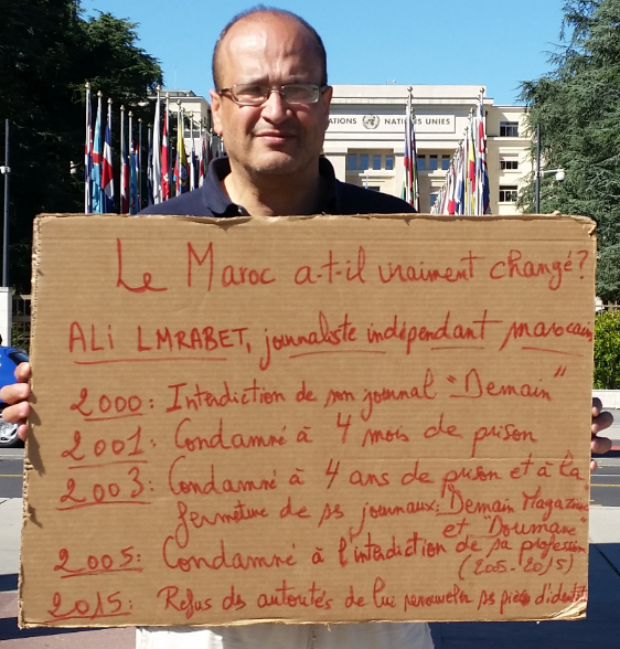
Petition online: http://linksito.com/51ze

alisanspapiers.blogspot.com (French) / alisinpapeles.blogspot.com (Spanish)

@AliLmrabet #alilmrabetID

sábado, 25 de julio de 2015

CPJ: Moroccan king must allow Ali Lmrabet to practice journalism


Sherif Mansour/CPJ Middle East and North Africa Program Coordinator
The Committee to Protect Journalists today joined 161 organizations, writers, journalists, human rights defenders, lawyers, and politicians in calling on the king of Morocco to stop the administrative harassment of Ali Lmrabet. The satirical journalist has been on hunger strike outside the U.N.'s Geneva offices since June 24, according to news reports.
Lmrabet is protesting the Moroccan government's refusal to renew his passport and residency papers, which he says is a move to prevent him from teaming up with his old cartoonist colleagues to resume publishing a satirical magazine, Newsweek reported.
In 2005, Lmrabet was banned from practicing journalism for 10 years after referring in an article to the Saharawi people in the Algerian city of Tindouf as refugees, contradicting the Moroccan government's position that they were prisoners of the Polisario Front-a movement fighting for the independence of the Western Sahara. The journalism ban expired in April this year.
Lmrabet has been harassed repeatedly for his criticism of the Moroccan government. In May 2003, he was jailed for "insulting the king" and "challenging the territorial integrity of the state" when his two weeklies, the now-shuttered French-language Demain and the Arabic Douman, published articles and cartoons that lampooned the monarchy, as well as an interview with an opponent of the king who called for self-determination for the people of the Western Sahara. Lmrabet served nearly nine months of his three-year sentence before being pardoned and released in January 2004.
Read the full letter to King Mohammed VI here.
[Reporting from Washington, D.C.]

jueves, 23 de julio de 2015

Index of Censorship: “He is denied his right to an identity”: why a Moroccan satirist is on hunger strike

By Milana Knezevic / 22 July 2015

Ali Lmrabet is on hunger strike outside the UN building in Geneva (Photo: alisinpapeles.blogspot.com.es)
Ali Lmrabet is on hunger strike outside the UN building in Geneva (Photo: alisinpapeles.blogspot.com.es)

Outside the United Nations building in Geneva, Switzerland, Ali Lmrabet is in his 28th day of a hunger strike. The journalist and satirist is protesting what he sees as the latest bid from his country Morocco to stop him from doing his job.
In a period spanning over a decade, Lmrabet, who was the editor of two satirical publications, has continuously been targeted by Moroccan authorities. In 2003, he was jailed for reporting on personal and financial affairs of Morocco’s King Mohammed VI. His magazine Demain was banned. Though initially handed down a three-year sentence, Lmrabet was released after six months. But his troubles were far from from over: in 2005, he was banned from practising journalism in his home country for ten years, over comments made about the dispute in Western Sahara between Morocco and the Algerian-backed Polisario Front.
Now authorities are seemingly using bureaucracy as a tool to try and silence Lmrabet again. As his ban expired in April this year, he returned to Morocco with the aim of relaunching Demain. But there he was denied a residency permit, without which he is unable to set up the magazine. In a further complication, he also needs the residence permit to renew his passport. When this expired on 24 June, Lmrabet, who was in Geneva to participate in a session of the UN Human Rights Council, decided to start a hunger strike.
“He is very tired,” his partner Laura Feliu told Index on Censorship in a phone interview. She explained how the heat in Geneva has played a part in leaving Lmrabet drained of energy, and while he hasn’t had any serious health problems, he is experiencing sensations of seasickness.
Lmrabet’s protest takes place outside the UN offices, though a heatwave forced him to move inside on Sunday. He sleeps in a Protestant church near the centre of the city. Subsisting on water and some sugar and salt, he has lost at least seven kilograms since the start of the strike.
“He started a hunger strike to protest because he has been denied the right to work as a journalist,” Feliu explained. But in addition to having his free expression and press freedom curtailed, he also has another problem, she adds: “He is denied his right to an identity.”
Lmrabet has support in his country. Some 100 well-known Moroccans from the worlds of media, human rights and academia have signed a petition to the government calling on him to be allowed to renew his documents and continue his work in journalism. Independent and prominent human rights organisations in Morocco are also backing him, according to Feliu.
The response from Moroccan authorities, meanwhile, has so far been unsympathetic. The country’s UN ambassador Mohamed Aujjar has urged Lmrabet to contest what he labelled an “administrative decision” in Morocco, telling AFP that “you don’t get your papers by staging a hunger strike”. Lmrabet, on his part, is unwilling to risk being stranded in Morocco without papers and the ability to work or leave the country. “No one trusts the judical system in Morocco,” he said.
Feliu says it’s difficult to know what the outcome will be, but that Lmrabet is convinced this is the only way to protest. And he remains hopeful.
“He is very convinced of his fight. He is very convinced of his cause. He says that he has the moral to do it.”

sábado, 18 de julio de 2015

Citizens Declaration PRESS RELEASE - Urgent JOURNALIST ALI LMRABET’S HUNGER STRIKE


We will not allow Ali Lmrabet to die as a result of the hunger strike he began June 24, 2015
We are calling for a protest to show our solidarity with Ali through a symbolic hunger strike by those who are able to do so.

Where: Place des Nations in front of the United Nations in Geneva
When: This Saturday, July 25th, 2015 at 14:30

By our citizen-gathering this Saturday, July 25, 2015 in Geneva, we want to call world attention to the fact that the Moroccan journalist Ali Lmrabet, whose intellectual honesty, courage, and determination is known by all, may perish if his hunger strike continues.
Through this hunger strike, which will have lasted for one month (24 June - 25 July 2015), Ali Lmrabet has been protesting against having been deprived of his rights as a Moroccan citizen. In point of fact, the Rabat authorities have not only arbitrarily refused to provide him with proof of residence or the renewal of his passport, but also any official permission which would allow him to relaunch his newspapers and to freely exercise his profession as a journalist in Morocco.
Having been illegally sentenced in 2005 to imprisonment without parole, and prohibited him from writing article in the Moroccan press for a period of 10 years, Ali, when he reached the end of this never-before pronounced sentence (April 2015), decided to fight relentlessly to wage war with his pen.
During the 29th session of the Council of Human Rights in Geneva, in which he participated as a guest beginning on June 23, he forcefully denounced the Moroccan government’s recourse to this completely unacceptable act of
refusing to grant him his official documents in order to disguise their refusal to allow him to begin publishing his newspapers again; Ali could only fall back on the single dramatic alternative of a hunger strike.

To date, the Geneva authorities have protested these events directly to the Moroccan King himself, they advised the Federal Council on the Ali’s unacceptable and unwarranted punishment, they addressed the Ambassador representing the Permanent Mission of the Kingdom of Morocco to the UN in Geneva, but these efforts were all in vain.
An international media campaign reported on these protests, which are also those of thousands of citizens around the world. The Moroccan authorities have not budged and persist in denying the rights of journalist Ali Lmrabet

By our gathering on July 25 and our symbolic hunger strike with Ali, we hope to persuade the Moroccan government through rational discourse and oblige it to immediately return to Ali Lmrabet, a father of two, all his identification documents which will allow him to return to his country and thus prevent a fatal outcome to his hunger strike.

We are grateful for your solidarity and hope as many of you as possible will be present this July 25, 2015 in Geneva.

For the Organizing Committee
Profesor. Ahmed Benani
Geneva, 17 July 2015

martes, 7 de julio de 2015

menara.ma: Ali Lmrabet asks Moroccan prime minister to intervene

In a long letter to prime minister Abdelilah Benkirane, journalist Al Lmrabet asked him to intervene in order to get his Moroccan passport and ID-card. According to Lmrabet the Moroccan authorities refuse to grant him the documents. “If you don’t intervene I will be a ‘sans-papier’ in my own country”, Lmrabet wrote. Lmrabet has been on hunger strike since June 24. He tried for months to get his documents in his city of birth Tetouan.
“Morocco is a state of law,” said Mohamed Aujjar, Morocco’s ambassador to the United Nations in Geneva, insisting the journalist had “every right to contest the administrative decision” not to provide him with a certificate needed to renew his passport. “But you don’t get your papers by staging a hunger strike,” he told the French news agency AFP. Aujjar said that if Lmrabet disagreed with the administrative decision he could challenge it, but not in Geneva.
Lmrabet flatly rejected Aujjar’s suggestion to return to Morocco and pursue the case in court, insisting he would then be stuck in the country with no papers and no possibility to work or leave. He is still in front of the UN’s offices in Geneva pursuing his hunger strike. Remy Pagani, one of the five members of Geneva’s Administratice Council, has written a letter to king Mohammed VI insisting that “Ali could obtain his ID-documents as soon as possible and resume his professional activities in his country, the kingdom of Morocco”.
Ambassador Aujjar denied to Moroccan news agency MAP that there was any legal decision to deprive the journalist from his ID documents. Lmrabet simply could not get his residence permit from the authorities in Tetouan because he was not actually living there. “He could have resorted to a legal procedure if there is a conflict between him and the local administration, like any other citizen”, according to Aujjar, who accused Llmrabet to turn a simple administrative dispute in a political and media campaign against Morocco.
Remains the question why the Moroccan authorities permitted this conflict to get out of hand. Llmrabet is no “ordinary citizen” but a journalist with a long record of confrontations with the Moroccan authorities over human rights and media freedom issues. Putting obstacles in Mr Llmrabet’s return to journalistic activity cannot be explained otherwise –in the Moroccan context than blunt political insensitivity or a clear red line against the freedom of expression of certain “troublesome” critics.
further reading:

lunes, 6 de julio de 2015

middle-east-online.com: Morocco journalist on hunger strike in Geneva told to return home

GENEVA - A Moroccan journalist on hunger strike in Geneva, who was previously jailed for insulting the Moroccan king and is now being denied a passport, was told Sunday to return home to plead his case.
"Morocco is a state of law," said Mohamed Aujjar, Morocco's ambassador to the United Nations in Geneva, insisting the journalist had "every right to contest the administrative decision" not to provide him with a certificate needed to renew his passport.
"But you don't get your papers by staging a hunger strike," he said.

Ali Lmrabet has been on hunger strike outside the UN's Geneva offices since June 24, when his Moroccan passport expired after months of vain attempts to renew it.

The journalist, who moved indoors Sunday amid a searing heatwave, said he had lost seven kilos (15.4 pounds) since he stopped eating.

Lmrabet maintains Morocco's refusal to renew his passport aims to block him from moving ahead with his plans to relaunch two satirical publications, after a 10-year-ban on him practising journalism was lifted in April.

He says he had requested the residence certificate needed to renew his passport on April 20, and had received the document only to see it withdrawn the next day.

The authorities said Lmrabet, whose wife and children live in Spain, did not live at his father's address in the northern city of Tetouan as claimed.

Aujjar said that if Lmrabet disagreed with the administrative decision he could challenge it, but not in Geneva.

Lmrabet flatly rejected Aujjar's suggestion he return to Morocco and pursue the case in court, insisting he would then be stuck in the country with no papers and no possibility to work or leave.

"No one trusts the judical system in Morocco," he said.

Lmrabet was the editor of two satirical publications -- one in French and one in Arabic -- that were banned in 2003 for insulting the king.

He was sentenced to three years behind bars, but was released on early 2004 after receiving a royal pardon.

But he ran into trouble a year later over comments about the ultra-sensitive Western Sahara dispute between Morocco and the Algerian-backed Polisario Front, and was barred from practising journalism for 10 years.

The journalist also holds French citizenship, but said he cannot under Moroccan law use his French passport, which has in any case also expired, to live and work in Morocco.

domingo, 5 de julio de 2015

Valdemar Andersen: Prepare your cells, we are ready

"As there isn't a real opposition, the regime thinks that we are the opposition. That isn't our role. This means there is something wrong with the system"

The words above were spoken two months ago by Ali Lmrabet, a journalist and former editor of the satirical magazine Demain. Demain was met a long row of obstructions from the regime, ending Lmrabet in prison at one time before finally prohibiting him from publishing for 10 years. 2015 was to mark a new beginning and he was contemplating opening a new satirical magazine of which Khalid Gueddar would a key participant, only once again "the system" to stay in the lingua answered back. This time denying Lmrabet a renewal of his national ID.

The ID has been denied on a technicality, promising for another long row of legal battles, securing him from publishing all the while.

Now the turn has come to Khalid Gueddar, who has been sentenced to three months in jail for a fictional act of misconduct. The sort of random accusations to pull out of the drawer when such a thing is needed, veiling that is an act against his profession and his freedom to carrying it out.

But of course it is. This is another attempt to silence him. Beneath is his communiqué of today, telling his story in his own words and a cartoon on that very situation. Note the half concealed star of the flag, which created such problems to him not that long ago:


By Khalid Gueddar

First of all, I wish to thank each and everyone, who have expressed their solidarity and support to me.

It was by chance that I learned the news of my sentence of three months imprisonment by the trial court in Kenitra. Neither my lawyers nor I have been notified of the conviction. Worse, no summons was sent to me not by this court.

Indeed, I attended two sessions of the trial, which began in 2012. I subsequently decided not to appear before the court of the judge. The case was postponed.

Three years have passed and now they dust off the record. I am under no illusions about the matter: this sentence is my freedom of expression. It happens at that very moment when my colleagues Ali Lmrabet, Ahmed Senoussi and I are preparing to launch a new satirical magazine. Long awaited by our team, this magazine would mark a new beginning for my colleague and friend Ali Lmrabet in the clipboard, after being sentenced to a prohibition on practicing journalism for 10 years (2005-2015).

Also, this magazine will offer a space of freedom to my friend and colleague, the comedian Ahmed Senoussi (Bziz), banned from all scenes and tribunes of the country.

Immediately after the announcement of the launch of this magazine, the Moroccan authorities decided to deprive Ali Lmrabet of his papers that will allow him to renew his identity card, and thus remove the legal record of the new media. Today, he continues his hunger strike he started it a few days ago in Geneva.

It is no secret: the Moroccan regime is afraid of humor and professional journalism, and its animosity against journalists is increasing day by day.

Seeing that there is no justice in Morocco, especially not in the courts, I declare today that I shall not present myself at meetings of the appeal trial, which will start on Wednesday, July 15.

They judge me as they wish. They will never take my freedom.

Gueddar
Cartoonist
Sunday, July 5, 2015.

The cartoon shown is courtesy of Khalid Gueddar and must not be reproduced without his permission.

http://valdemarandersen.blogspot.com.es/2015/07/prepare-you-cells-we-are-ready.html

AFP: Morocco reporter on hunger strike in Geneva should return home: Rabat


Geneva (AFP) - A Moroccan journalist on hunger strike in Geneva, who was previously jailed for insulting the Moroccan king and is now being denied a passport, was told Sunday to return home to plead his case.
"Morocco is a state of law," said Mohamed Aujjar, Morocco's ambassador to the United Nations in Geneva, insisting the journalist had "every right to contest the administrative decision" not to provide him with a certificate needed to renew his passport.
"But you don't get your papers by staging a hunger strike," he told AFP.
Ali Lmrabet has been on hunger strike outside the UN's Geneva offices since June 24, when his Moroccan passport expired after months of vain attempts to renew it.
The journalist, who moved indoors Sunday amid a searing heatwave, told AFP he had lost seven kilos (15.4 pounds) since he stopped eating.
Lmrabet maintains Morocco's refusal to renew his passport aims to block him from moving ahead with his plans to relaunch two satirical publications, after a 10-year-ban on him practising journalism was lifted in April.
He says he had requested the residence certificate needed to renew his passport on April 20, and had received the document only to see it withdrawn the next day.
The authorities said Lmrabet, whose wife and children live in Spain, did not live at his father's address in the northern city of Tetouan as claimed.
Aujjar said that if Lmrabet disagreed with the administrative decision he could challenge it, but not in Geneva.
Lmrabet flatly rejected Aujjar's suggestion he return to Morocco and pursue the case in court, insisting he would then be stuck in the country with no papers and no possibility to work or leave.
"No one trusts the judical system in Morocco," he said.
Lmrabet was the editor of two satirical publications -- one in French and one in Arabic -- that were banned in 2003 for insulting the king.
He was sentenced to three years behind bars, but was released in early 2004 after receiving a royal pardon.
But he ran into trouble a year later over comments about the ultra-sensitive Western Sahara dispute between Morocco and the Algerian-backed Polisario Front, and was barred from practising journalism for 10 years.
The journalist also holds French citizenship, but said he cannot under Moroccan law use his French passport, which has in any case also expired, to live and work in Morocco.